
Why Do Muslims Pray Five Times a Day?
By Eric Karim Johnson·Published November 2, 2026
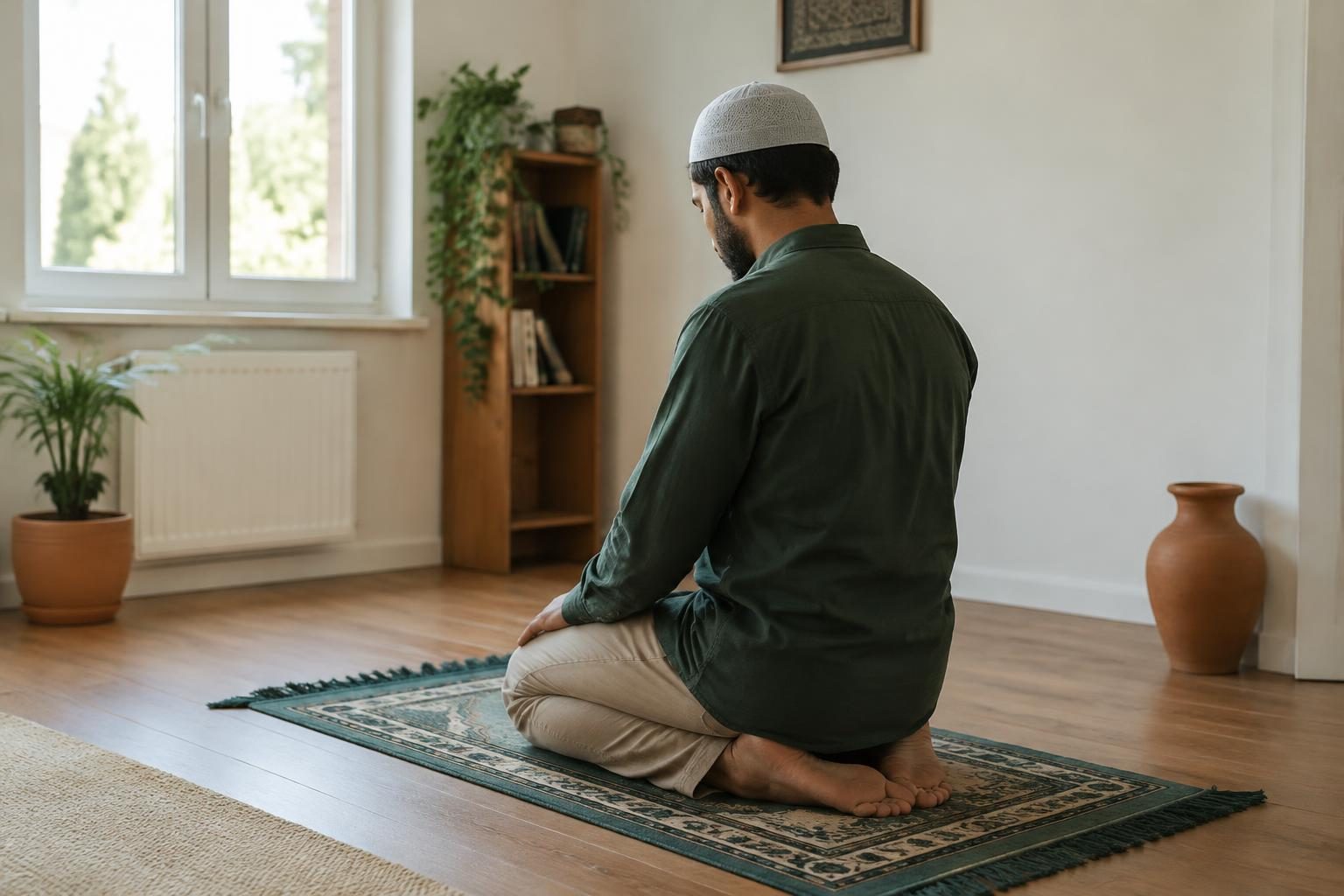
If you’ve ever spent time around Muslims, you may have noticed something: at certain moments of the day, they stop what they’re doing to pray.
It could be early in the morning, during a lunch break, in the middle of a working day, or late in the evening. Wherever they are, many Muslims organize part of their daily routine around these five prayers.
But why five times a day? Why not once, like in some other religious traditions? And why repeat the same act of worship throughout the day?
These are fair questions, especially if you’re not familiar with Islam. But the answer is about much more than simply following a religious rule. Prayer is one of the central ways Muslims remember God, find direction, and bring faith into their everyday lives.
Let’s take a closer look.
Why Do Muslims Pray Five Times a Day?
Muslims pray five times a day because it is a central obligation of Islam. These daily prayers are known as Salah (or Salat).
According to Islamic belief, God prescribed the five daily prayers and taught them through the Prophet Muhammad (peace be upon him). They are not simply optional moments of reflection; they are essential to practicing Islam.
The five prayers take place at different times:
- Fajr: before sunrise, in the early morning.
- Dhuhr: after the sun has passed its zenith, so to speak, around midday.
- Asr: In the afternoon.
- Maghrib: Just after sunset.
- Isha: at night once the twilight is gone.
The exact times change throughout the year, depending on the location and the sun's movement.
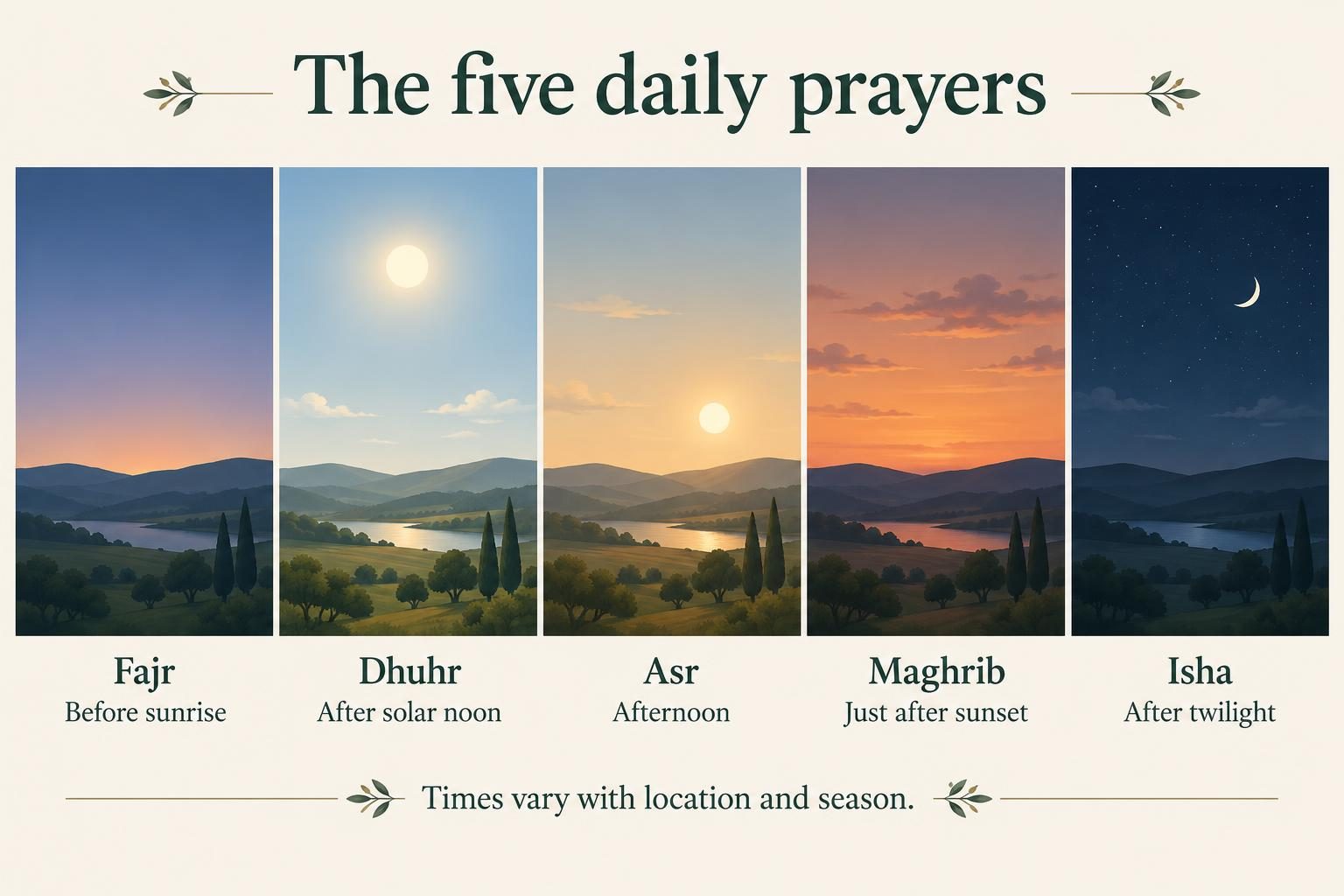
For Muslims, these five moments create a rhythm throughout the day. In this way, rather than thinking about God only when something goes wrong or when they need help, they are reminded to turn towards Him regularly.
What Is the Purpose of Praying Five Times a Day?
To understand why Muslims pray five times a day, it helps to look beyond the physical actions. In other words, prayer means more than the movements themselves.
Prayer in Islam has several purposes.
To remember God
Everyday life can become busy quickly. Work, family, responsibilities, and personal problems can take over our attention.
The five daily prayers create moments to step away from all of that and remember God.
For Muslims, this is an opportunity to reconnect with the One they believe created them and gave their lives meaning.
To express gratitude
Prayer is also a way of thanking God.
Muslims don’t only pray when they want something. They pray to acknowledge what they have already been given: life, health, family, opportunities, and countless things often taken for granted.
To ask for guidance and forgiveness
In prayer, Muslims ask God to guide them toward what is right, forgive their mistakes, and help them become better people.
One of the most frequently recited chapters of the Quran, Al-Fatiha, includes the words:
“Guide us to the straight path.” (Quran 1:6)
If you’d like to read this chapter for yourself, my Quran-in-English beginner guide explains how to get started.
It's a straightforward request, but one with considerable significance. In this way, the verse points to prayer's deeper purpose.
To create discipline and consistency
Praying five times a day requires organization and commitment. It means setting aside time for something important even on a busy day.
For many Muslims, this regular practice helps bring structure and discipline into their lives.
Why Five Prayers? Why Not Just One?
This is perhaps the question that naturally follows.
Why did God prescribe five daily prayers rather than one longer prayer in the morning or evening?
In Islamic belief, the number five comes from divine instruction. It is not something Muslims chose simply because it seemed like a convenient routine.
According to Islamic tradition, the five daily prayers were prescribed during the Night Journey and Ascension (Al-Isra wal-Mi’raj) of Muhammad (peace be upon him).
The traditional account describes an initial prescription of fifty prayers, which was reduced to five while retaining the reward of fifty.
You can find the account in well-known collections of Islamic hadith, including Sahih al-Bukhari and Sahih Muslim.
For Muslims, this story explains the special importance of the five daily prayers. It also helps show why the prayers are spread across the day.
There is also something practical about their distribution throughout the day. Because the prayers are spaced out, they offer repeated opportunities to pause, reflect, and reconnect with God rather than leaving worship for one particular moment.
What Do Muslims Actually Do During Prayer?
If you’ve seen Muslims praying, you may have noticed that it involves a series of movements rather than simply standing and speaking.
Prayer follows a specific structure, combining recitation, standing, bowing, and prostration.
A typical prayer consists of the following components:
- Standing: Reciting verses of the Qur'an, beginning with Al-Fatiha.
- Bowing: an act of humility towards God.
- Prostration: placing the forehead on the ground as an act of submission and humility.
- Sitting: Muslims say further prayers and supplications.
Before praying, Muslims perform a ritual washing called Wudu. This involves washing specific parts of the body, including the hands, mouth, face, arms, and feet.
Muslims also face the Kaaba in Mecca when they pray. This direction is known as the Qibla. It gives Muslims worldwide a common direction of prayer, wherever they are.
That shared practice crosses cultural boundaries. I explore this distinction further in Is Islam an Arab Religion?.
Although the movements are repeated, the intention is not simply to perform a physical routine. Rather, each prayer is an act of worship.
Do Muslims Have to Pray Even When They’re Busy?
Yes, daily prayer is an obligation for Muslims, but Islam also recognizes that life is not always straightforward.
People work, travel, study, look after children, and deal with unexpected situations. Islamic teachings include certain allowances for travel and illness.
For example, travelers may shorten some prayers, and people who are ill may pray in a way their condition allows.
Muslims are also encouraged to pray within the prescribed time windows rather than at one exact minute. This gives some flexibility in organizing the day.
Of course, how people manage prayer in practice can vary depending on their circumstances and understanding of Islamic teachings. Even so, the obligation remains central.
Can You Understand Islam Without Understanding Prayer?
Probably not entirely.
Prayer is one of the Five Pillars of Islam, alongside the declaration of faith, charity, fasting during Ramadan, and pilgrimage to Mecca for those who are able.
It is difficult to understand how Islam shapes a Muslim’s everyday life without understanding the role of Salah. In that sense, prayer is central to the faith’s daily rhythm.
For many Muslims, prayer is not separate from ordinary life. It shapes how they approach it.
It can be a moment of peace during a stressful day, a reminder to be grateful when things are going well, or an opportunity to ask for guidance when life becomes difficult.
That doesn’t mean every Muslim experiences prayer in the same way. But its central place in Islamic practice is shared.
So, Why Do Muslims Pray Five Times a Day?
Muslims pray five times a day because they believe God prescribed these prayers as a regular act of worship and a way to maintain their relationship with Him. This makes prayer part of daily life.
These prayers express faith, gratitude, humility, and discipline. They create regular moments throughout the day to step back from distractions and remember what matters most.
You don’t have to be Muslim to appreciate the idea behind taking time out of a busy day to reflect on your purpose and the direction of your life.
Perhaps the most interesting thing about the five daily prayers is that they turn faith into something practiced throughout the day, rather than something remembered only on special occasions. They make belief part of daily life, not just a moment of thought.
And that’s a strong starting point for understanding Islam.
Discover Islam. Think for yourself.